
The Art of Persuasion: How Argumentative Writing Skills Fuel High-Stakes Business Negotiations

In the high-pressure environment of a corporate boardroom, the difference between a signed contract and a missed opportunity often hinges on more than just “market fit.” It depends on the structural integrity of an argument. While many view argumentative writing as a purely academic exercise relegated to college lecture halls, the cognitive frameworks developed through this discipline are the secret engines of successful business negotiations.
Modern negotiation is no longer about who speaks the loudest; it is about who builds the most indestructible logical case. From defending a Series B valuation to navigating complex cross-border mergers, the ability to synthesize data, anticipate rebuttals, and deliver a structured narrative is paramount.
The Structural Parallel: From Essays to Executives
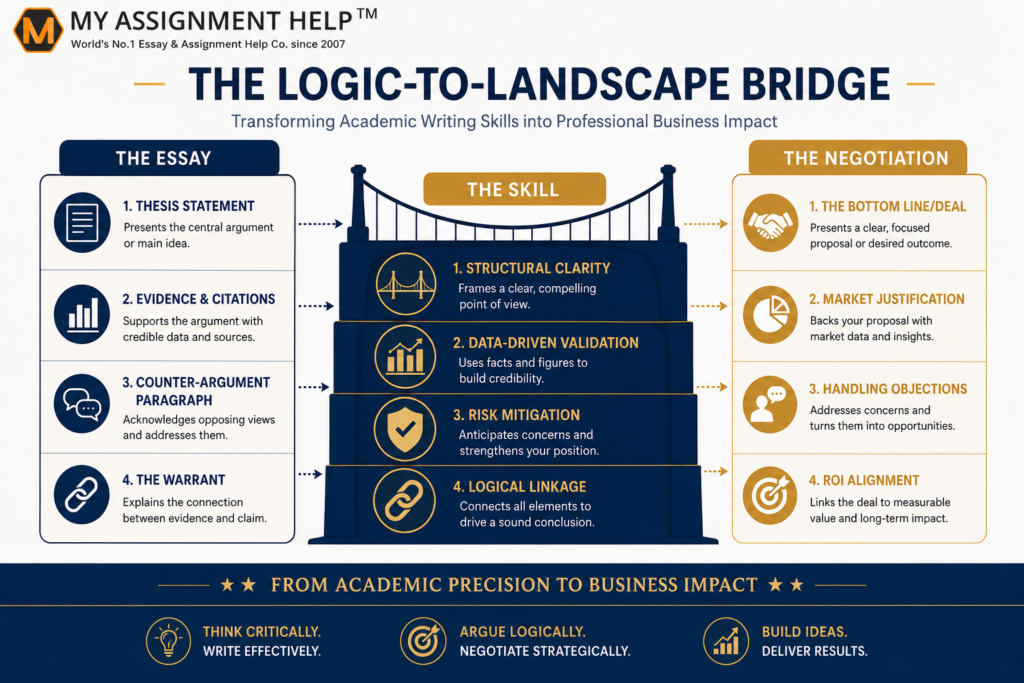
At its core, a high-stakes negotiation is a live, spoken version of a complex argumentative paper. Both require a clear thesis (the desired outcome), evidence-based support (market data), and the strategic address of counterarguments (risk mitigation).
Professionals who have mastered the nuances of rhetorical appeals—Ethos, Pathos, and Logos—find themselves at a distinct advantage. When you are tasked with convincing a stakeholder to pivot a multi-million dollar strategy, you are essentially “selling” a perspective. For those who feel their foundational skills in this area are lacking, seeking professional essay writing help online can provide a blueprint for how to structure these complex thoughts. Understanding how to transition from a claim to a warrant is a skill that translates directly from the page to the negotiation table.
Why Argumentative Proficiency is a Business Asset
Research indicates that cognitive flexibility—the ability to shift between different concepts or to think about multiple concepts simultaneously—is a top predictor of negotiation success. Argumentative writing trains the brain in this exact type of flexibility.
When you prepare a comprehensive brief for a business deal, you are engaging in a process of “Steel-manning” the opposition. This involves building the strongest possible version of your opponent’s argument to better understand how to dismantle it. This level of preparation ensures that when a client raises an objection, you aren’t caught off guard; you’ve already written the “rebuttal section” in your mind.
For students or emerging professionals looking to sharpen these tools, the resources at myassignmenthelp offer practical examples of how to balance evidence with rhetoric. Many individuals choose to buy an argumentative essay from such platforms not just for the submission, but to use as a study guide for professional communication. Learning how to cite sources and back every claim with data is a habit that prevents “fluff” from devaluing a business proposal.
Data-Driven Insights: The ROI of Persuasion
According to a report by the Harvard Program on Negotiation, “integrative negotiation”—where parties work to create value rather than just claim it—results in 42% higher long-term contract adherence. Argumentative writing teaches the “integrative” approach by forcing the writer to find common ground (the “concession”) before proving why their primary claim is superior.
The Skill-to-Salary Bridge: Communication Literacy
| Skill Set | Application in Business | Impact on Career Growth |
| Evidence Synthesis | Analyzing market trends to justify costs. | High (Essential for C-Suite) |
| Counter-Argumentation | Handling objections in real-time. | Critical for Sales/Business Dev |
| Structural Logic | Creating clear, easy-to-follow proposals. | Medium to High (Project Management) |
Strategies for Integrating Argumentative Skills into Negotiations
1. The “Logic-to-Landscape” Mapping
Before entering a meeting, map out your “claim” against the current market “landscape.” If you are arguing for a budget increase, your evidence shouldn’t just be “we need it,” but a data-driven narrative of “Opportunity Cost.”
2. Anticipatory Rebuttal
In writing, we call this the “Counter-argument paragraph.” In business, this is the “FAQ” or “Risk Assessment.” Addressing the “elephant in the room” before your opponent does builds immense Ethos (credibility).
See also: Teaching Kids Smart Money Habits Through Digital Apps
3. The Power of the Warrant
In the Toulmin Model of argumentation, the “warrant” is the logical connection between your data and your claim. Many negotiators present data but fail to explain why that data supports their specific conclusion. Writing forces you to bridge that gap explicitly.
Key Takeaways
- Structure is King: High-stakes deals require the same introduction-body-conclusion flow as a professional essay to ensure clarity.
- Evidence-Based Trust: Using external data and “citations” (market reports) builds trust and satisfies the “Expertise” component of professional interactions.
- Emotional Intelligence (Pathos): While logic wins the argument, understanding the “audience’s” pain points is what closes the deal.
- Refinement: Continuous practice in written argumentation improves verbal agility during stressful cross-examinations.
Conclusion
The transition from a student writing a thesis to an executive closing a deal is a shorter path than most realize. The mental muscle memory developed through argumentative writing provides a framework for clarity, persuasion, and resilience. By treating every business proposal as a high-level argumentative piece, you ensure that your points are not just heard, but are logically undeniable.
Frequently Asked Questions (FAQ)
Q: How does writing help if I am a verbal communicator?
A: Writing acts as a “flight simulator” for communication. It allows you to see the gaps in your logic that are often hidden by tone or charisma during verbal speech.
Q: Can I use these skills for internal team management?
A: Absolutely. Persuading a team to adopt a new workflow requires the same “Claim-Evidence-Warrant” structure as a formal negotiation.
Q: Is “Argumentative” the same as “Aggressive”?
A: No. In professional writing and business, an “argument” is a technical term for a reasoned, logical case. It is the opposite of aggression; it is a collaborative effort to find the most logical truth.
Author Profile: Mark Sterling
Senior Content Strategist & Academic Consultant at MyAssignmentHelp
Mark Sterling has over 15 years of experience in corporate communications and educational strategy. Specializing in the intersection of rhetoric and modern business practices, Mark has helped thousands of students and professionals master the art of structural persuasion. He currently leads the content development team at myassignmenthelp, ensuring that all educational resources meet the highest standards of E-E-A-T and professional utility.
References:
- Harvard Program on Negotiation (2024). “The Power of Integrative Bargaining.”
- Toulmin, S. (2003). “The Uses of Argument.” Cambridge University Press.
- Fisher, R., & Ury, W. (2011). “Getting to Yes: Negotiating Agreement Without Giving In.
