Thinking like a mobile robotics company: how teams cut time-to-field without building from scratch

TL;DR: To reduce time-to-field robotics, teams usually get the biggest schedule gains by reusing a proven mobile base instead of starting with mechanics, power, safety, and low-level software from zero. A ready-made robot platform can turn a proof-of-concept robot into a testable system faster because the engineering effort moves from infrastructure to mission logic, sensing, autonomy, and integration.
How can time-to-field robotics improve when teams stop building every layer from scratch?
In mobile robotics, schedule pressure rarely comes from one hard algorithm. It comes from stacking many necessary but non-differentiating tasks: chassis design, drivetrain sizing, battery integration, motor control, wiring, enclosure work, thermal checks, remote access, and software bring-up. This is where time-to-field robotics is usually won or lost.
From an engineering manager’s perspective, the problem is simple: a team wants field data, stakeholder feedback, and integration results, but the project starts by consuming months on platform basics. That makes planning harder because physical robot development contains dependencies that software-only teams do not face. One delayed part can block testing across the whole stack.
A practical way to reduce time-to-field robotics is to treat the mobile base as infrastructure. If the project goal is inspection, teleoperation, autonomy research, mapping, or remote sensing, the value is often in payload behavior and software integration, not in redesigning suspension geometry or motor controllers. In that case, a ready-made robot platform or robot development platform becomes a schedule control mechanism, not just a hardware shortcut.


For teams comparing options, Fictionlab mobile robots illustrate this category of ready platforms used as a base for UGV development, prototyping, education, and field testing.
What usually slows time-to-field robotics in early project phases?
When teams estimate time-to-field robotics, they often account for navigation, perception, or application logic, but underestimate integration work. What early delay looks like in practice is less about one dramatic failure and more about repeated small blockers.
The most common sources of delay tend to include the following areas:
- Mechanical iteration caused by weight growth, mounting conflicts, or drivetrain constraints
- Electrical integration issues such as power distribution noise, unstable connectors, or battery management decisions
- Low-level software work for motor drivers, communications, sensor interfaces, and watchdog behavior
- Environmental testing gaps, especially outdoors where dust, rain, slope, and wheel slip affect performance
- Field serviceability problems, where a minor repair or sensor swap takes too long during testing
- Remote operations gaps, including networking, SSH access, teleoperation links, and logging
These are not exotic problems. They are normal UGV development tasks. The issue is that they consume calendar time before the team can answer the product question that actually matters: does the robot solve the target use case?
Why does a ready-made robot platform change the development schedule?
A time-to-field robotics plan improves when a platform already solves the repeated engineering work found in most mobile robot projects. What a ready-made robot platform is, in practical terms, is a tested base with mobility, power, compute mounting, connectivity, and software support prepared for payload work.
This changes the schedule in three ways.
First, parallel work becomes easier. Software engineers can start on ROS 2 nodes, autonomy logic, or cloud interfaces while the physical robot is already operational. Second, hardware risk is reduced because the team is integrating on top of a known drive base instead of validating every subsystem at once. Third, field testing starts earlier, which matters because outdoor robotics often reveals issues that bench testing misses.
For a proof-of-concept robot, this is especially useful. A proof-of-concept robot is not meant to prove perfect final industrial packaging. It is meant to prove task execution, sensor suitability, operator workflow, and deployment assumptions. If a ready platform reaches that stage faster, the team gets real evidence sooner.
How does a robot development platform differ from a custom UGV build?
In time-to-field robotics, what a robot development platform is differs from a full custom build mainly in where engineering effort is spent. A custom UGV development path starts with base mobility architecture and then adds mission capabilities. A robot development platform starts with mobility already available and focuses effort on payload integration and behavior.
The trade-off can be described clearly:
- A custom build offers maximum control over dimensions, wheelbase, electronics layout, and industrialization path
- A robot development platform offers faster bring-up, earlier testing, and fewer foundational unknowns
- A custom build is often justified when hard constraints already exist for payload size, regulatory design, or environmental requirements
- A ready-made robot platform is often useful when the project still needs to validate sensing, autonomy, teleoperation, or user workflow assumptions
This is why many teams use a platform first and delay custom hardware decisions until after field learning. In schedule terms, that keeps time-to-field robotics focused on decision-critical knowledge instead of front-loading infrastructure work.
When does using Leo Rover make sense for a proof-of-concept robot or UGV development?
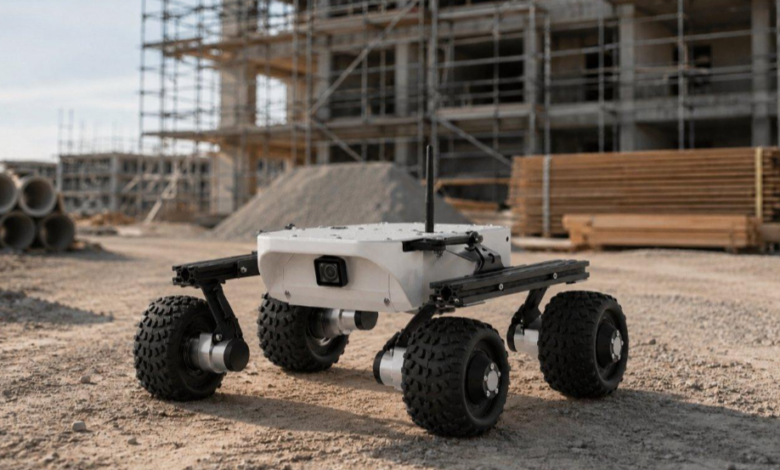
For time-to-field robotics, the Leo Rover fits projects where teams need an operational outdoor mobile base for experiments, demonstrations, education, or early product validation. Leo Rover is a small unmanned ground vehicle designed to be programmable and accessible, which makes it relevant as a proof-of-concept robot base or robot development platform.
In practical engineering terms, platforms such as Leo Rover are useful when the immediate need is to test one or more of these items:
- ROS 2 application logic on a real moving robot
- Sensor payloads such as cameras, LiDAR, GNSS, or environmental modules
- Teleoperation and remote inspection workflows
- Outdoor autonomy pipelines under non-laboratory conditions
- Customer or stakeholder demos that require a reliable mobile base
For larger-scale or heavier-duty UGV development, the same logic applies to higher-capability platforms. The key point is not the exact vehicle class but the engineering pattern: use a tested base when the project needs learning velocity more than chassis reinvention.
What should engineering teams check before selecting a platform to reduce time-to-field robotics?
Not every platform helps time-to-field robotics equally. The relevant question is not only what the robot can do on paper, but how quickly the team can integrate, debug, and test on it.
Before adopting any ready-made robot platform, it is useful to verify the following points:
- Whether the payload space, power budget, and mounting options fit the intended sensors and compute hardware
- Whether remote access, logging, and software deployment are straightforward for the team’s workflow
- Whether ROS 2 integration and developer documentation are mature enough for fast onboarding
- Whether spare parts, maintenance access, and routine field repairs are practical
- Whether the platform’s mobility envelope matches the real terrain, not just indoor test conditions
If these basics are covered, time-to-field robotics usually improves because testing can begin before the project commits to a final custom architecture.
How do teams turn faster field access into better engineering decisions?
The main benefit of better time-to-field robotics is not speed for its own sake. It is faster technical learning. Once a robot is in the field, teams can evaluate sensor placement, how autonomy differs from simulation behavior, and what operators actually need in real workflows.
That is why a ready-made robot platform often works well as an intermediate step between concept and product-specific hardware. It allows engineering teams to collect evidence before locking in expensive design choices. For projects under deadline pressure, that can be the difference between debating assumptions and testing them.
Teams exploring a proof-of-concept robot, a reusable robot development platform, or a practical starting point for UGV development can review Fictionlab’s platform lineup to compare which base best matches their sensing, autonomy, and terrain requirements.