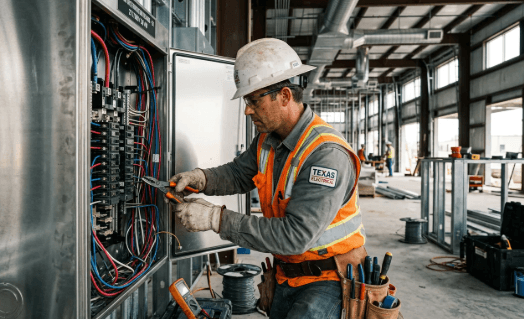
Texas businesses are facing a major workforce transition that could significantly impact the future of infrastructure growth across the state.
As experienced electricians and infrastructure professionals retire in growing numbers, companies involved in commercial construction, manufacturing, data centers, and industrial development are struggling to replace highly skilled labor.
At the same time, infrastructure demand continues increasing rapidly due to the growth of artificial intelligence, cloud computing, and commercial development.
The result is a highly competitive labor market where skilled electrical professionals are becoming some of the most valuable workers in the infrastructure economy.

The Skilled Trades Workforce Is Aging
For years, many industries underestimated the long-term impact of workforce aging within the skilled trades.
Today, those effects are becoming increasingly visible.
Many experienced electricians who supported large-scale commercial and infrastructure projects for decades are now approaching retirement age. As they exit the workforce, businesses are losing:
- technical expertise
- field leadership
- operational knowledge
- troubleshooting experience
- project management capabilities
Replacing this level of experience is not easy.
The shortage is becoming particularly noticeable in Texas, where infrastructure growth is accelerating across multiple industries simultaneously.
Data Center Expansion Is Increasing Demand
One of the biggest drivers of electrical hiring demand is the rapid growth of data center infrastructure.
Modern AI systems require enormous amounts of computing power, creating major demand for:
- power distribution systems
- electrical redundancy
- cooling infrastructure
- networking environments
- backup systems
- mission-critical operations
Data center environments require highly specialized electrical expertise capable of supporting continuous uptime operations.
As infrastructure projects continue expanding across Dallas–Fort Worth, Austin, Houston, and San Antonio, businesses are competing aggressively for qualified electrical professionals.
Companies such as Flex Tech are helping organizations support infrastructure staffing and workforce scalability as demand for experienced electrical professionals continues increasing across Texas.
Hiring Competition Is Intensifying
The combination of workforce retirements and infrastructure growth has created one of the most competitive hiring markets the skilled trades industry has seen in years.
Businesses are searching aggressively for:
- journeyman electricians
- foremen
- low-voltage specialists
- structured cabling professionals
- infrastructure technicians
- facilities support personnel
At the same time, fewer younger workers are entering the trades compared to previous generations.
This imbalance is increasing pressure on businesses attempting to scale infrastructure operations quickly.
Workforce Strategy Is Becoming a Business Priority
Many companies are beginning to recognize that workforce development is no longer simply an HR function.
It is becoming a core operational strategy.
Organizations are now investing more heavily in:
- apprenticeship programs
- technical recruiting
- trade partnerships
- retention initiatives
- certification support
- operational workforce planning
Businesses capable of building strong technical teams may ultimately gain significant operational advantages as infrastructure competition continues increasing.
Read also: Web Developer Discussion Hub a Nixcoders.Org Blog Sharing Technology Insights
The Future of Infrastructure Depends on Skilled Labor
The future of Texas infrastructure growth depends heavily on skilled technical professionals.
As AI infrastructure, commercial development, and industrial operations continue expanding, the need for experienced electrical talent will likely continue rising across the state.
Businesses that invest in workforce scalability now may ultimately be best positioned to support the next phase of infrastructure growth.
Because while technology may continue evolving rapidly, infrastructure still depends on people capable of building and maintaining it.