By a roof restoration industry contributor.
The bill for keeping a good roof over our heads is climbing. In 2024 alone, the cost of roof repairs and replacements in the United States hit nearly $31 billion, according to Verisk, a company that tracks insurance data. That number is up almost 30 percent in just two years. For homeowners, this isn’t just a number. It means that every leak, missing shingle, or dent from a hailstorm costs more to fix.
Severe weather is the main reason for this price jump, as wind and hail are now the main drivers of home insurance claims for roof damage. This can turn a small problem into a big, expensive project. That is why modern Restoration Contractors roof repair services involve more than just patching a roof. The work now often includes handling tricky insurance claims, sourcing hard-to-find materials, and fixing hidden structural damage that a quick inspection might miss.
With the average roof repair cost now at $4,699, per Verisk, understanding the process is more important than ever. You need a clear plan to check the damage, write it all down, and choose a contractor who can handle the whole job.


Quick answer: Roof repair costs are rising because of more frequent storms and higher material prices. To manage this, you must carefully document all damage for your insurance claim, understand the difference between a simple patch and a full restoration, and ask contractors specific questions about how they handle storm-related issues.
What’s inside
- Why are roof repair costs increasing so rapidly?
- How do you evaluate a contractor for storm damage repair?
- How can you effectively navigate the insurance claim process?
- Frequently Asked Questions
- The Bottom Line: Your Roof Is Now a High-Stakes Project
Why are roof repair costs increasing so rapidly?
Costs are going up because of more frequent severe weather, higher material prices, and changes in the insurance market. Your roof isn’t just getting old anymore. It’s now facing major changes in weather and the economy that cost you money.
How often storms happen and how strong they are are the biggest factors. In states that get a lot of severe weather, the effect is clear. For example, a report from the Oklahoma Insurance Department found that severe hail hit nearly half of all roofs in the state over a recent four-year period. When one storm can damage tens of thousands of homes, it creates a huge, sudden need for materials and workers, which raises prices for everyone nearby. This isn’t just a local problem. It affects the supply of materials all over the country.
Besides the cost of shingles, the work itself has gotten more complicated. Modern roofs include parts like vents, underlayment, and flashing. High winds or hail can damage all of these parts. A repair after a storm is rarely just about replacing the shingles you can see. It often means a deep inspection of the whole roof to find hidden leaks or weak spots in the structure. This takes more time to find the problems and requires a higher level of skill from the crew.
This trend has not gone unnoticed by the insurance industry. Roof problems now make up more than a quarter of the total cost of all home insurance claims, according to Verisk. Because of this, insurance companies are getting stricter about approving claims and what paperwork they require. A claim with weak proof that might have been approved five years ago is more likely to be questioned or denied today. This could leave you paying for a much bigger part of the bill.
❝ A good rule of thumb is that if more than 25% to 30% of your roof is damaged, a full replacement is often cheaper and more reliable in the long run than just patching it.
How do you evaluate a contractor for storm damage repair?
You check a contractor by making sure they have a local license and insurance, asking for a detailed list of all the work they will do, and knowing the warning signs of “storm chasers” who are just passing through. The quality of your repair depends more on these checks than on the first price you get. A low bid from an unqualified crew can lead to denied insurance claims and future leaks.
First, check their license and insurance. A real contractor will have a local office and can show you their current state or city license. For projects in Denver, for example, you can verify a contractor’s status directly through the city’s official Community Planning and Development portal. Ask for proof of both general liability insurance and worker’s compensation. Without this, any accident on your property could become your problem to pay for.
Next, look closely at their written offer. A simple one-page estimate with a total price is a major red flag. A professional scope of work should be a detailed document that lists:
- The exact type and manufacturer of shingles, underlayment, and flashing.
- The plan for removing and disposing of the old roofing material.
- Details on replacing any damaged roof decking (plywood).
- Specifics on ventilation and ice and water shield installation.
- A clear payment plan based on when parts of the job are finished, not a large payment before they start.
After a major hail or wind event, watch out for contractors who suddenly appear in your neighborhood. These “storm chasers” often move from town to town. They do fast, poor-quality work and then leave town before you notice problems with their warranty. The table below shows key differences.
| Feature | Vetted Local Contractor | Potential Storm Chaser |
| Physical Address | Has a permanent, local office and shop. | Uses a P.O. box or has no local address. |
| Licensing | Provides a verifiable local license number. | Vague about licensing or has an out-of-state license. |
| Insurance | Shows proof of general liability and worker’s comp. | May lack proper insurance, putting you at risk. |
| Payment Terms | Asks for a deposit, with final payment on completion. | Demands a large upfront payment or the full amount. |
| Contract | Provides a detailed, itemized contract. | Uses a high-pressure, simple agreement. |
| Deductible | Explains you are responsible for your deductible. | Offers to “waive” or “absorb” the deductible. |
❝ An offer to “cover” your insurance deductible is not a clever discount; it is a sign of possible insurance fraud. The contractor usually makes up the difference by billing the insurance company for work that was not performed or by using cheaper materials. This can put your claim at risk and leave you with a bad repair.
How can you effectively navigate the insurance claim process?
You handle the process by treating your claim like a business project, with clear proof and good paperwork. The key is to get a complete report on the damage from a trusted contractor before the insurance adjuster arrives. This changes the situation. Instead of just accepting the insurance company’s first offer, you are giving them a detailed plan for the work that needs to be done.
The process usually includes two separate inspections. The first is from your insurance company’s adjuster. Their job is to find damage caused by the storm and figure out the repair cost using their software. The second is from your contractor. Their job is to find all the damage and figure out what it will take to get your roof back to how it was before the storm, while following today’s building rules. These two reports can be very different.
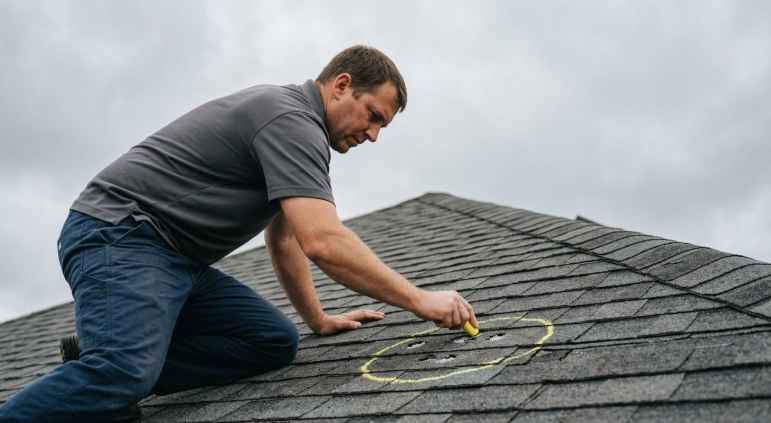
A good contractor’s report will go beyond the shingles. It should include proof of “collateral damage.” This is damage to other parts of your property that shows how bad the storm was. This includes dents on metal gutters, downspouts, air conditioner fins, and window wraps. This proof helps show how strong the hail or wind was. That makes it harder for an insurance company to say the damage is just from old age. The contractor should also do a “test square.” This means they mark a 10-by-10-foot area on each side of the roof to count the number of hail hits. This gives them solid numbers that match how the insurance industry measures major damage.
❝ Your contractor should offer to meet the adjuster on-site during their inspection. This isn’t about starting a fight. It’s about working together. When they can both look at the roof together and talk about the needed repairs, there’s a much smaller chance of problems or a denied claim.
In the end, your insurance policy is a contract. It requires the insurer to pay for specific types of damage. Your role is to provide clear proof that can’t be argued with. A detailed report, photos of the damage, and a contractor who understands the insurance process are your best tools.
See Also: The Silent Killers of E-commerce Growth: 5 Fulfillment Traps to Avoid
Frequently Asked Questions
Are roof restoration services worth it? Yes, because they prevent small problems from becoming major disasters. Paying for a professional repair now saves you from much bigger costs later, like water damage inside your house, mold removal, and a weakened home structure. Waiting to fix a problem almost always means the final bill will be much higher.
What is the 25% rule for roofing? The “25% rule” is a guideline that says if more than about a quarter of your roof is damaged, a full replacement is usually more practical than a repair. Patching several large areas can cost almost as much as a new roof, and it is very hard to match new shingles to older, weathered ones. Some local building codes also have their own version of this rule, so ask your contractor how it applies where you live.
How much does the average roof repair cost? Verisk puts the average repair at about $4,700, but that number mixes small fixes with big section replacements. Your cost depends mostly on three things: the roofing material (asphalt costs less than slate or metal), how steep your roof is (steeper roofs need more safety gear and labor), and how much damage is found in the roof deck once the old shingles come off.
How long does a typical roof repair take? Most small repairs, like replacing some shingles or sealing a leaking vent, take a single day. A larger repair to one section of the roof might take two to three days. A full replacement on an average home usually takes a few days, but weather, material deliveries, and city inspections can stretch that out.
The Bottom Line: Your Roof Is Now a High-Stakes Project
Fixing a damaged roof is no longer a simple construction job. Higher material costs and closer review from insurance companies mean that good paperwork now matters as much as good work on the roof. A good result depends less on finding the lowest bid and more on a careful, proof-based approach.
Your most important job is to focus on the process, not just the final price. The contractor who gives you the most detailed list of work, records all the collateral damage, and can work professionally with your adjuster is giving you better service. That care up front protects you from half-finished repairs, surprise costs, and the stress of a denied claim.
In the end, the goal is not just to hire a crew but to build a clear case for fixing your home the right way. A repair backed by photos and a professional report protects your home’s value long after the storm has passed.